Meta titles and meta descriptions are two of the most important elements of on-page SEO. They help search engines understand what your page is about while encouraging users to click your website from the search results.
Even if your content ranks well, a weak or poorly written meta title and description can result in fewer clicks. On the other hand, a compelling meta tag can improve your click-through rate (CTR), drive more organic traffic, and help your website stand out from competitors.
In this guide, you’ll learn how to write effective meta titles and descriptions, common mistakes to avoid, and best practices to improve your SEO performance.
What’s Included in This Article?
- What meta titles and meta descriptions are
- Why they matter for SEO
- Best practices for writing optimized meta titles
- Tips for creating compelling meta descriptions
- Common mistakes to avoid
- Examples of good and bad meta tags
- Tools to help optimize your metadata
What Is a Meta Title?
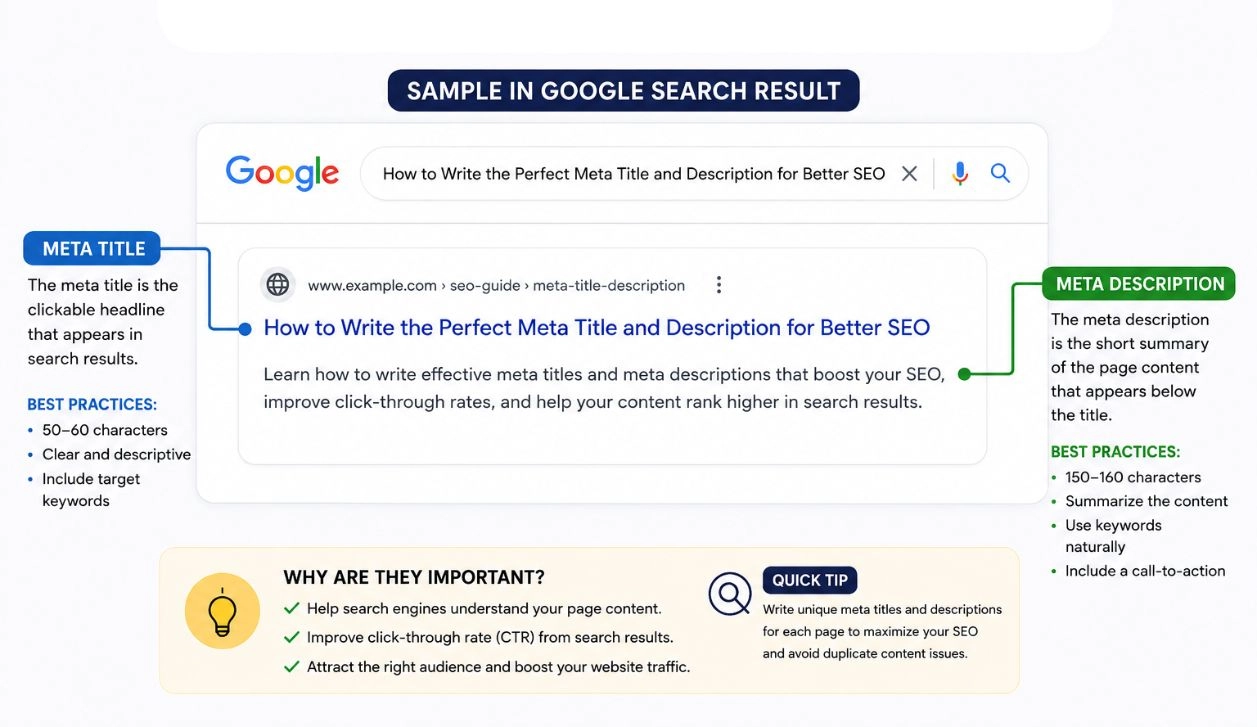
A meta title, also called a title tag, is the clickable headline that appears on search engine results pages (SERPs). It tells both search engines and users what your page is about.
For example:
How to Write the Perfect Meta Title and Description for Better SEO
This is the first thing users see when your page appears in Google, making it one of the most influential ranking and engagement factors.
A well-written meta title should:
- Clearly describe the page
- Include your primary keyword
- Be unique for every page
- Encourage users to click
What Is a Meta Description?
A meta description is the short summary displayed below your page title in search results.
Although it isn’t a direct ranking factor, it plays a significant role in improving click-through rates.
Example:
Learn how to write SEO-friendly meta titles and descriptions that improve rankings, increase clicks, and attract more organic traffic.
A strong meta description gives users confidence that your page contains the information they’re looking for.
Why Meta Titles and Descriptions Matter for SEO
Many website owners spend hours creating high-quality content but overlook their metadata.
That’s a mistake because your title and description act as your webpage’s advertisement in search results.
Good metadata can:
- Improve organic click-through rates
- Increase website traffic
- Help search engines understand page relevance
- Improve user experience
- Support keyword targeting
- Reduce bounce rates by setting clear expectations
Even if Google occasionally rewrites your title or description, providing optimized metadata gives search engines the best possible starting point.
How to Write the Perfect Meta Title
Creating an effective meta title isn’t difficult if you follow a few proven guidelines.
1. Include Your Primary Keyword
Place your main keyword naturally near the beginning of the title whenever possible.
Instead of:
Learn Everything About SEO Metadata
Try:
How to Write the Perfect Meta Title and Description
This immediately signals relevance to both users and search engines.
2. Keep It Between 50–60 Characters
Google doesn’t measure titles by character count alone—it uses pixel width—but keeping titles around 50 to 60 characters helps prevent truncation.
Example:
How to Write the Perfect Meta Title and Description
Too long:
Everything You Need to Know About Writing Meta Titles and Meta Descriptions That Improve Every Website’s SEO Performance
3. Make Every Page Unique
Avoid using the same title across multiple pages.
Each page should target its own topic and keyword.
For example:
- Home Page
- SEO Services
- Web Design Services
- Contact Us
- Blog Articles
Every page deserves its own optimized title.
4. Add Your Brand Name When Appropriate
Many businesses include their brand at the end of the title.
Example:
How to Write the Perfect Meta Title and Description | Absolute Websites
This helps increase brand recognition while keeping the primary keyword prominent.
5. Write for Humans First
Keywords matter, but readability matters more.
Avoid stuffing keywords like this:
Meta Title Meta Description SEO Meta Tags Best Meta Title SEO
Instead:
How to Write the Perfect Meta Title and Description for Better SEO
How to Write an Effective Meta Description
The best meta descriptions explain the page while encouraging users to click.
1. Keep It Around 150–160 Characters
Descriptions that are too long may be cut off in search results. Aim for a concise summary that communicates value.
2. Include Your Primary Keyword Naturally
Google often bolds keywords that match a user’s search query.
Example:
Learn how to write the perfect meta title and description with practical SEO tips that improve visibility and increase clicks.
3. Explain the Value
Tell users exactly what they’ll gain.
Instead of:
This page talks about SEO.
Try:
Discover practical tips for writing optimized meta titles and descriptions that improve search visibility and attract more clicks.
4. Use Action Words
Encourage engagement with action-oriented language.
Examples:
- Learn
- Discover
- Improve
- Boost
- Find out
- Explore
- Increase
These words make descriptions more compelling.
5. Match the Page Content
Never promise something the page doesn’t deliver. Misleading descriptions may increase clicks initially but often result in higher bounce rates and lower user satisfaction.
Common Meta Title Mistakes
Avoid these common SEO errors:
Keyword Stuffing – Using the same keyword repeatedly looks spammy and reduces readability.
Duplicate Titles – Every page should have its own unique title.
Generic Titles
Titles like:
- Home
- Services
- Blog
- Page 1
provide little value to search engines or users.
Titles That Are Too Long – Long titles may be truncated, making important information invisible.
Common Meta Description Mistakes
Watch out for these issues:
- Leaving descriptions blank
- Using duplicate descriptions
- Writing descriptions that are too long
- Not including relevant keywords
- Making misleading claims
- Using robotic or unnatural wording
Good vs. Bad Examples
| Good | Bad |
| How to Write the Perfect Meta Title and Description for Better SEO | SEO Meta SEO Meta Title Meta Description SEO |
| Learn how to write compelling meta titles and descriptions that improve rankings and increase clicks. | This page contains information about SEO. |
The good examples are descriptive, readable, and optimized without sounding forced.
Helpful Tools for Optimizing Meta Tags
Several SEO tools can help you create better metadata:
- Google Search Console
- Rank Math
- Yoast SEO
- SEMrush
- Ahrefs
- Screaming Frog SEO Spider
These tools help identify duplicate metadata, missing tags, title length issues, and optimization opportunities.
Best Practices Checklist
Before publishing any page, make sure you:
- Write a unique meta title
- Write a unique meta description
- Include your primary keyword naturally
- Keep titles around 50–60 characters
- Keep descriptions around 150–160 characters
- Focus on readability
- Match the page content
- Add a compelling reason to click
- Avoid keyword stuffing
- Review how your page appears in search results
Following this checklist can improve your site’s visibility and encourage more users to visit your pages.
Final Thoughts
Writing the perfect meta title and description is one of the simplest yet most effective ways to improve your SEO. While they may seem like small details, they have a significant impact on how users interact with your website in search results.
By creating clear, keyword-focused, and engaging metadata, you can improve click-through rates, support your overall SEO strategy, and help search engines better understand your content.
Make metadata optimization a standard part of your publishing process. With consistent effort, you’ll build stronger search visibility and attract more qualified organic traffic over time.
Your website deserves more than just great content—it deserves metadata that attracts clicks and drives results. At Absolute Websites, we help businesses optimize every aspect of their SEO, from keyword research and technical improvements to compelling meta titles and descriptions that increase visibility.
Whether you’re building a new website or improving an existing one, our team can help you create an SEO strategy that delivers long-term growth. Contact Absolute Websites today to discover how professional SEO services can help your business rank higher and reach more customers.
Key Takeaways
- Meta titles are the clickable headlines shown in search results.
- Meta descriptions summarize your page and encourage users to click.
- Include your primary keyword naturally in both.
- Keep titles around 50–60 characters and descriptions around 150–160 characters.
- Avoid duplicate, generic, or keyword-stuffed metadata.
- Write for users first while following SEO best practices.
- Regularly review and update your metadata to improve search performance.