Web development is changing quickly. Businesses now need websites that work across desktops, smartphones, apps and other digital platforms. This has led to growing interest in headless web development.
But what does “headless” actually mean?
In simple terms, headless web development separates the part of a website that users see from the system that manages the content behind it. This gives developers more freedom when building the front end while allowing businesses to manage content through a separate system.
For some businesses, this can provide greater flexibility and better control. However, headless development is not the right choice for every website.
What’s Included in This Article?
This guide explained:
- What headless web development means
- How headless websites work
- What a headless CMS is
- The difference between headless and traditional websites
- The main benefits of headless development
- Potential drawbacks and added complexity
- When businesses should consider a headless website
- Why headless development is not always the best option
What Is Headless Web Development?
Headless web development is an approach where the front end and back end are separated.
The front end is everything visitors see and interact with, such as:
- Website pages
- Menus and navigation
- Images and videos
- Forms
- Product displays
- Buttons and interactive features
The back end is where content and other website data are managed.
With a traditional website, these parts are usually closely connected. A content management system (CMS), such as WordPress, can manage the content while also controlling how that content is displayed.
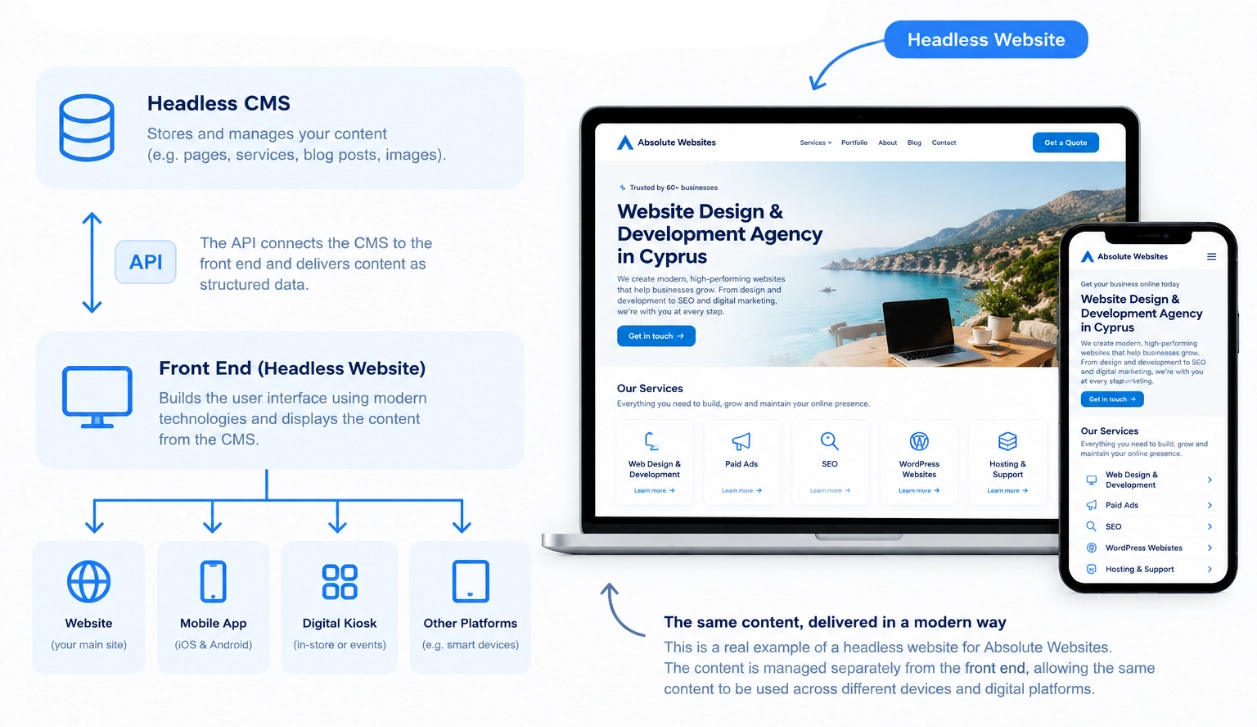
With a headless approach, the CMS manages the content separately. The front end then requests that content through an API.
This means the same content can potentially be delivered to different websites, applications and digital platforms.
How Does Headless Web Development Work?
A headless website normally has three main parts: the content management system, API and front end.
The CMS stores and manages content. The API acts as the connection between the CMS and the applications that need the content. The front end then takes that information and displays it to visitors.
For example, imagine a business has product information stored in a headless CMS.
That information could be requested by:
- The main website
- A mobile application
- A customer portal
- Another digital platform
Instead of creating separate versions of the same content for every platform, the content can be managed in one place and delivered where it is needed.
WordPress can also support this type of setup through its REST API. WordPress provides API endpoints that allow applications to request posts, pages, media and other content as structured data.
What Is a Headless CMS?
A headless CMS is a content management system without a fixed presentation layer.
The “head” refers to the front end that displays content. A headless CMS removes that connection, allowing developers to build the front end separately.
This is different from a traditional CMS, where content management and website presentation are normally part of the same system.
A headless CMS can make content easier to reuse across different digital channels. For example, a business could manage an article once and use the content on its website, application or other digital services.
The front end can also be built using modern development technologies without being restricted by the CMS’s normal themes or templates.
Headless vs Traditional Web Development
The main difference is how the website’s front end and back end are connected.
| Traditional Website | Headless Website |
| Front end and back end are connected | Front end and back end are separated |
| CMS usually controls content and presentation | CMS mainly manages content |
| Often simpler to build and maintain | Usually requires more development |
| Themes and templates can control design | Front end can be built independently |
| Suitable for many standard websites | Useful for complex digital experiences |
A traditional CMS can be an excellent option for a business that needs a professional website, blog, service pages or online shop without unnecessary technical complexity.
Headless development becomes more useful when a business needs greater control over how content is delivered and displayed.
What Are the Benefits of Headless Web Development?
Greater Front-End Flexibility
One of the biggest benefits is freedom over the front end. Developers are not limited to the normal templates or themes provided by a CMS. They can use the technology and framework that best suits the project. This can be useful for businesses that need highly customised digital experiences.
Content Can Be Used Across Multiple Platforms
Headless systems can make it easier to reuse content across different channels. A business may have one source for its product descriptions, articles, images or other information while different applications request that content through an API. This can reduce the need to maintain the same information in several places.
Potential Performance Benefits
A headless architecture can support fast, highly optimised front ends. Developers can choose how pages are generated, cached and delivered. With the right architecture, this can help create a fast experience for website visitors.
However, headless development does not automatically make a website faster. Performance still depends on the technology, hosting, code, images, APIs and overall implementation.
More Control Over Digital Experiences
Businesses with complex websites may need more than a standard template-based setup. Headless development gives developers greater control over how information is presented and how different systems interact. This can be valuable for larger organisations with websites, applications and other digital products.
What Are the Drawbacks of Headless Development?
Headless development also comes with additional complexity. Because the front end and back end are separated, more development work may be required. Businesses may need specialist developers to build, connect and maintain the different parts of the system.
There can also be more systems to monitor and maintain. For a small business with a straightforward website, this added complexity may not provide enough value to justify the additional development time and cost.
A traditional WordPress website, for example, may provide everything the business needs without requiring a separate front-end application.
When Should a Business Consider a Headless Website?
Headless development may be worth considering if your business:
- Needs the same content across several digital platforms
- Requires a highly customised front end
- Has complex integrations with other systems
- Operates a large or content-heavy digital platform
- Needs greater control over the user experience
- Has an in-house technical team or access to specialist developers
On the other hand, a traditional website may be more suitable if you need a simple business website, company blog, portfolio or standard online shop.
The goal should not be to use the newest technology simply because it is available. The technology should support the business’s actual needs.
Is Headless Web Development Right for Your Business?
There is no single solution that works for every website.
For some companies, headless web development can provide the flexibility needed to create advanced digital experiences. For others, it may introduce unnecessary complexity.
WordPress remains a practical option for many businesses because it combines content management with a large ecosystem of themes, plugins and development tools. It can also be extended through its REST API when a project needs content to be accessed by separate applications.
For businesses considering headless development, the first step should be to understand the project requirements. This includes the type of content being managed, the number of platforms involved, required integrations, performance goals and future plans.
A professional web development team can then determine whether a traditional, headless or hybrid approach makes the most sense.
Frequently Asked Questions
Is headless web development better than traditional web development?
Not necessarily. Headless development provides more flexibility, but it also adds complexity. A traditional CMS may be a better choice for businesses with straightforward website requirements.
Can WordPress be used for headless web development?
Yes. WordPress provides a REST API that allows external applications to access WordPress content. This makes it possible to use WordPress as a content management system while building a separate front end.
Is headless web development suitable for small businesses?
It can be, but it may not always be necessary. Small businesses with simple websites may benefit more from a well-built traditional WordPress website that is easier to manage and maintain.
Does a headless website improve SEO?
Headless development does not automatically improve SEO. Search performance still depends on factors such as site structure, content, technical SEO, page speed, mobile usability and proper implementation.
Does headless development cost more?
It can. Building and maintaining separate front-end and back-end systems may require more development time and technical expertise than a traditional website.
Build the Right Website for Your Business
Headless web development can offer powerful benefits, but choosing the right architecture is more important than choosing the latest technology.
At Absolute Websites, we help businesses plan and build websites around their goals, users and technical requirements. Whether you need a professional WordPress website, an eCommerce platform or a more customised web development solution, the right approach starts with understanding what your business actually needs.
Contact Absolute Websites to discuss your next website project and find the right web development solution for your business.
Key Takeaways
- Headless web development separates the front end from the back end, giving developers more freedom over how a website looks and works.
- A headless CMS manages content separately from the website’s presentation layer.
- Headless development can make it easier to deliver the same content across websites, apps and other digital platforms.
- It can provide greater flexibility and customisation, particularly for larger or more complex projects.
- Headless websites can also introduce more development and maintenance work, so they are not the right choice for every business.
- Traditional WordPress development may be a better option for businesses that need a straightforward, easy-to-manage website.
- The best approach depends on the business goals, website requirements, integrations, budget and future plans.